 KnifeThrowing.info
 Sticking Point, Axtwerfen.de, Thrower, or Throwzini (many pictures)
 metal detector, dowsing rod, or magnets to find it.)
Planks make the best target, the thicker the better. 4 centimetres are the minimum, or else you will have to replace the target constantly, and will not be able to turn it round to (ab)use the unbattered side. The wood used for the construction of railway tracks will make the best target you can think of. Simply mount the planks on some (wooden) rack and rest them against a tree or a pole. (Take some rope to make sure it wont fall on the impact of the knives.) The target should stretch from the ground to about 25cm above your eye level and be at least 1m wide. You may use cheaper and thinner wood for the outer regions, they hopefully only have to catch stray throws. Be aware that thin planks that are not supported in the back will act as a trampoline and spring back the knives right towards yourself.
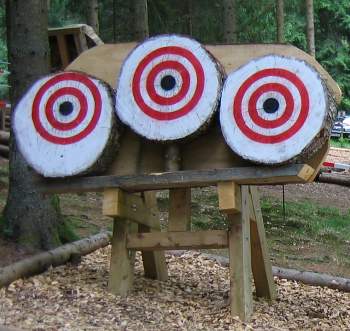
 Of course you can use multiple round tree slices (mounted on a rack, again), those wont insist on the knives arriving vertically. A drawback is that your thrower may fly through the holes between the slices. Do avoid wood of leafed trees, it tends to "throw back". Fir is better. Leave your target out in the rain, knives do really stick better in soaked wood.
Trees do not make good targets for several reasons: They would get cuts in the process, through which diseases can enter the tree. No tree holds up to this very long. And the throwing knives will sometimes hit vertically, bending to follow the round form of the tree. No throwing knife will support this for very long, either, but brake. Due to the cylindrical surface of the targets, knives will bounce back wildly in every direction.
Some people made positive experience using targets out of multiple layers of cardboard, especially when throwing indoors. But remember that when throwing indoors, the knives bouncing back from the target are especially dangerous, as they might ricochet from the walls, and you have less room to get out of their way. The best thing here would be an empty garage completely lined with carpet.
Below there is plenty of inspiration (and instructions) on building your own target. If you'd rather buy a ready-made target, do shop at AceJet.
 (bigger) |
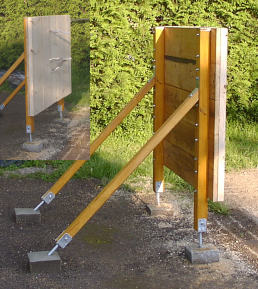
This rather solid target has been constructed by Rüdiger and Willi from Bavaria. They explain how they built it: "As there are two little children in the house (4 and 6 years of age), we have chosen to mount the target in a way that nobody can get behind it unnoticed while we are throwing. From a do-it-yourself store, we got the metal mountings and matching timbers (4 mountings and 2 timbers à 3 meters). We bought raw timbers and planed them ourselves to fit the mountings, it is much cheaper that way. Then we cut the timbers in half and installed the zinced mountings in the ground with the help of concrete. After the concrete was solid, we could screw the timbers to the mountings. Then we added two layers of planks: one layer of level planks, 3,5 cm think, was fastened to the timbers. Then a second layer, 5 cm thick, was attached to the first, this time vertical. The screws (6cm long) went in from the back of the target to prevent the knives from hitting them. We still ponder if and how we should paint a bullseye on the target." |
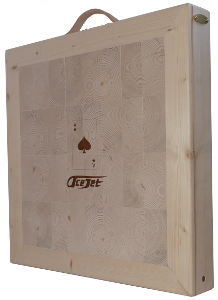 Portable targets come in rather handy. If the throwing bug bites you, just go into the garden and dangle them from something solid (not a tree, please). You even can even take them on the road in your trunk - the target here is made by AceJet and has a weight of only 8 kg. The glued blocks are not an ideal solution, but if it's not your main training target, the spruce blocks will last long enough. And of course the end grain wood means your knives just stick better.
|
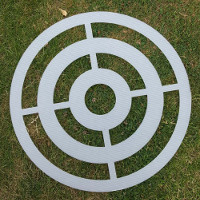
Using spray paint and a template you can quickly colour your knife throwing target. |
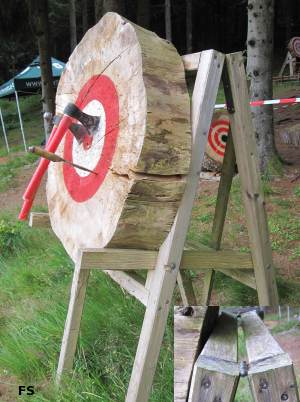
This knife and axe throwing target has been built by Holger Wycisk for the knife throwers competition in Herrischried, July 2010. The targets are tree rounds of white fir that had been cut 3 weeks before. The target holders were available in two flavours:
| Extremely sturdy: | Sturdy but still transportable: | |
|  |
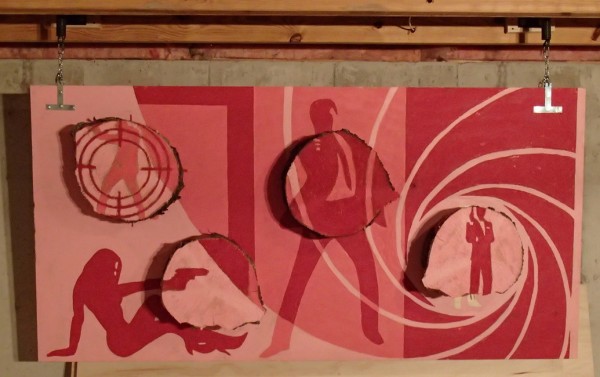
Why just built a target when you can design one? So, when Matthew's fiancée mentioned she really would like to learn how to throw knives, he heeded the construction hints on this page, and made her a kick-ass spy knife throwing target.
His blog Spy Throwing Knife Target has closeup photos of the setup, including one of the very sturdy ceiling mount. The free-swinging construction absorbs the impact of non-sticks, reducing bouncebacks to some extend. Still missing is the backstop (wood or carpet layers) behind the target that catches the throwing knives that go wide astray, and prevents them from breaking when they hit the concrete wall.
It's a pitty that after some days of serious throwing, so many wooden chips will have been hacked out of the target that the paint on the tree slices will all but have vanished.
|
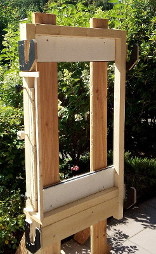
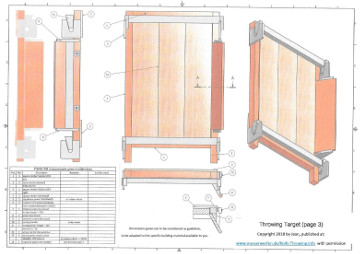
This is a target construction for knife throwing, where the wooden planks can be exchanged quickly. Jean even provided the construction blueprints including a list of parts. |
|
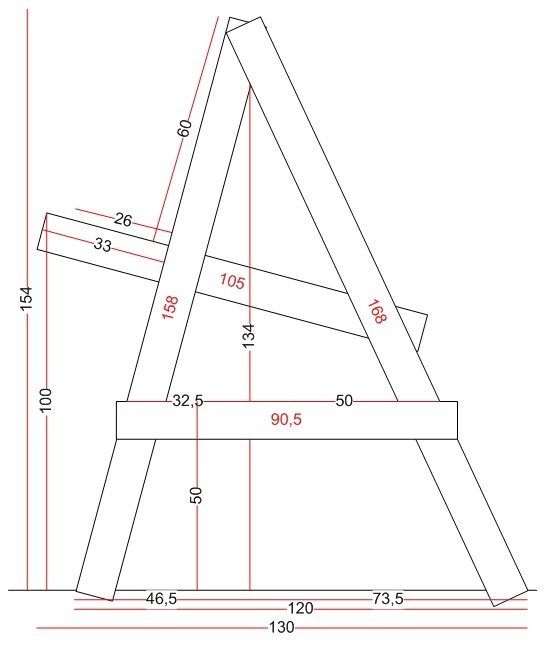
Heavy knives and axes are the favourite throwing toys of Roland Zwosta. That's why his throwing target is extra sturdy. The drawing and photos explain well how to construct the target. The tree-slice has a diameter of 55cm and a thickness of 40cm.
Material needed:| Blueprint: | Side- and rear-view: | |
 (bigger) |
 (bigger) |
There are more photos of this target in the German forum.
 (bigger)
|
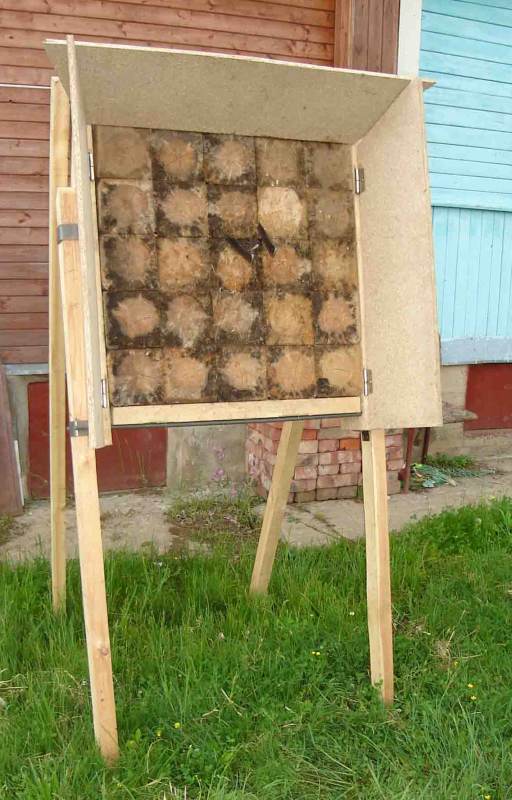
Yury Ershov (student of Y. Fedin) built this target, which he says is common in Russia. The frame squeezes the blocks of wood together so that they fit tight. The boards on the sides and on top can be closed for transportation to keep the blocks in, and provide handy protections to deflect knives that miss the target. If one of the blocks breaks apart from use, it can be easily replaced. The target is made wet before throwing so that the knives stick better. |
|
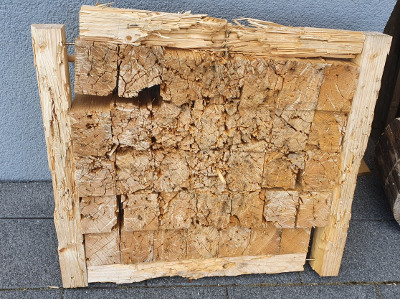
Knife throwing chews up target wood pretty quickly. Especially if you put all your force into the throw - something that your joints request you never do. The destroyed block target you see here lasted only two weeks with Bernd. As many knife throwers, he ended up using tree slices as target. Learning: If you need to build your target from wooden blocks - because you will throw light knives indoors, or because it's the only wood you can get - expect to replace them very frequently. Any construction that uses glue/screws/pegs to fix the blocks to each other is a bad idea. Consider using a tight tension belt to hold a circular arrangement of blocks together - just cover the metal parts of the belt to protect your knives. |
 (bigger) |
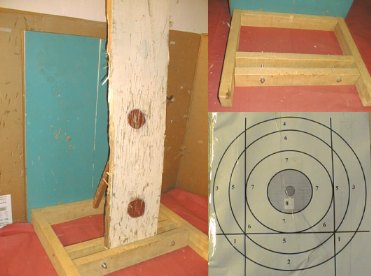
This is my "portable indoor knife throwing target" for the winter. It is quite simple. With the two screws you can fix the target plank between the two pieces of wood. The backstop is a pinboard. I can easily carry it around in my car, then simply put it on a table and start throwing! I thought it would be more interesting to throw at a target where the points are not distributed circular around the bullseye (that is same number of points for each ring) but to make sections. Now I get less points if I score in the bottom, making me fight more against gravity. The target lines are simply drawn on a piece of paper that is covered with transparent tape to prevent it from tearing too much. |
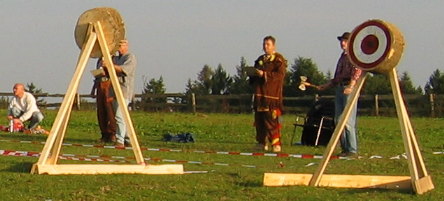 |
These targets were used at the throwers meeting 2005 in Pullman City. They proved to be very robust constructions. The two side stilts were screwed to the target round, the third stilt rests snugly fixed between them. The two planks that connect the stilts on the ground make the construction much more resistant to twisting forces, prolonging the life of the target. (This method is even more effective than using wire to connect the stilts on the ground.) Please notice that the targets are tilted a few degrees backwards, thus with the help of the prolonged planks preventing the target to fall forward. |
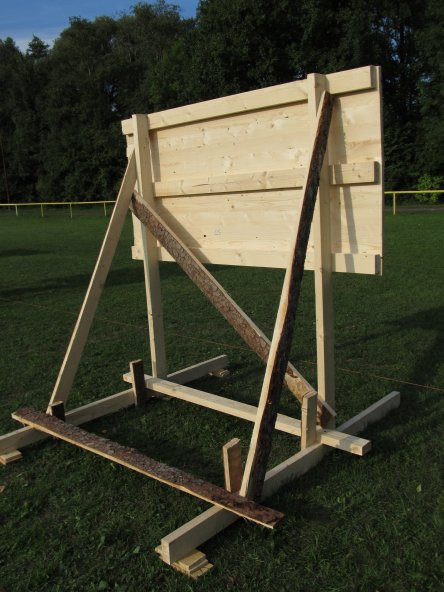 |
The sport has progressed since then, and at big competitions it is now customary to have three target logs for each thrower, mounted on a sturdy backdrop. On the photo you see the construction that was used at the Big Throwers Meeting 2013 in Nivnice. Built just for the three days of the competition, so rather raw wood was used. The four pegs in the ground secure the target in place, at a championship you want your distances to be correct to the centimeter even after heavy throwing. The fine red cord you see crossing the stilts was used for a common alignment of all the targets. |
|
|
|
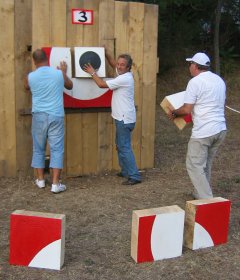
Sometimes you just need a huge target, for example the European Knife Throwing Rules |
|
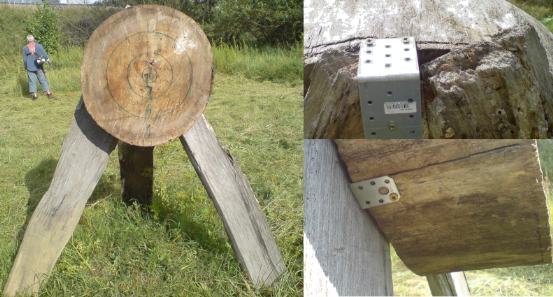
Using only some old wood, imagination and some iron, Stefan Roeder built a durable knife throwing target. |
|
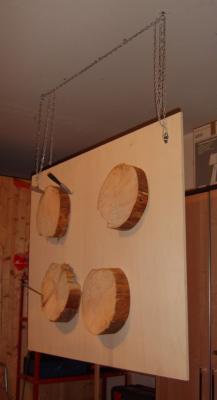
For his big cellar, |
 |
 (bigger)
|
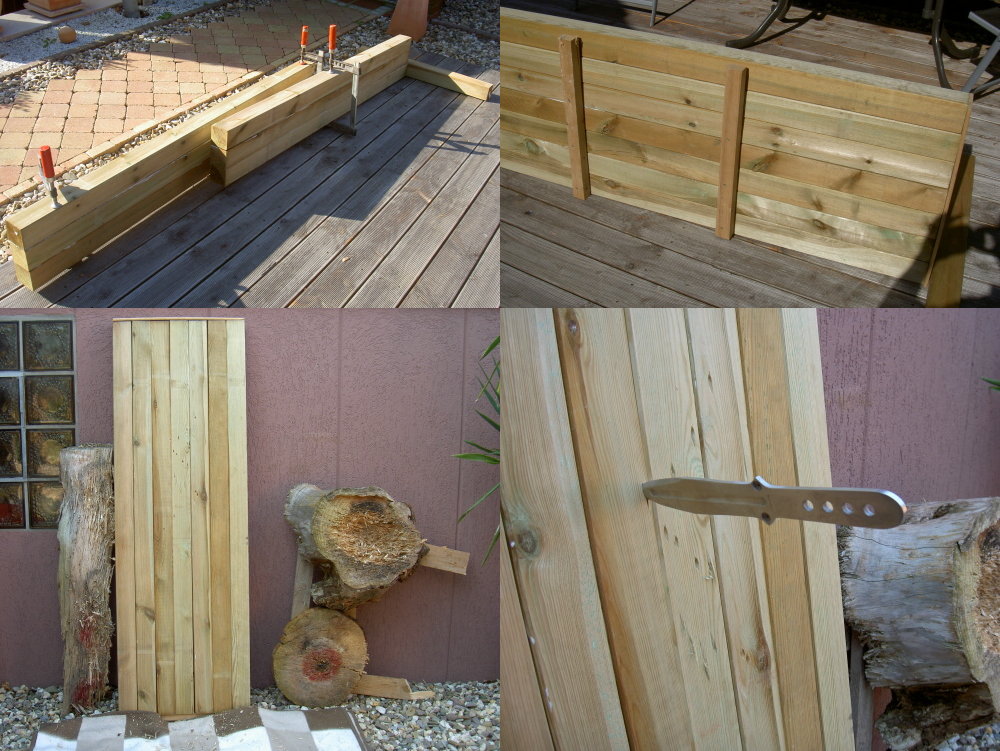
A short explanation on my knife throwing target. Up to now, I did not mount it on a base, since it is very stable as it is, leaning against the wall of my garage. The square-shaped timber balks are from a hardware store, they are normally used to construct fences. They measure approximately 90mm x 90mm (about a typical 4 x 4, for you Americans). For a start, I glued them together under pressure, then screwed planks on vertically and on top and bottom. Rock-solid now.
Because the wood does not splinter easily, it should be good for quite some throws.
Price for the balks: 49 Euros.
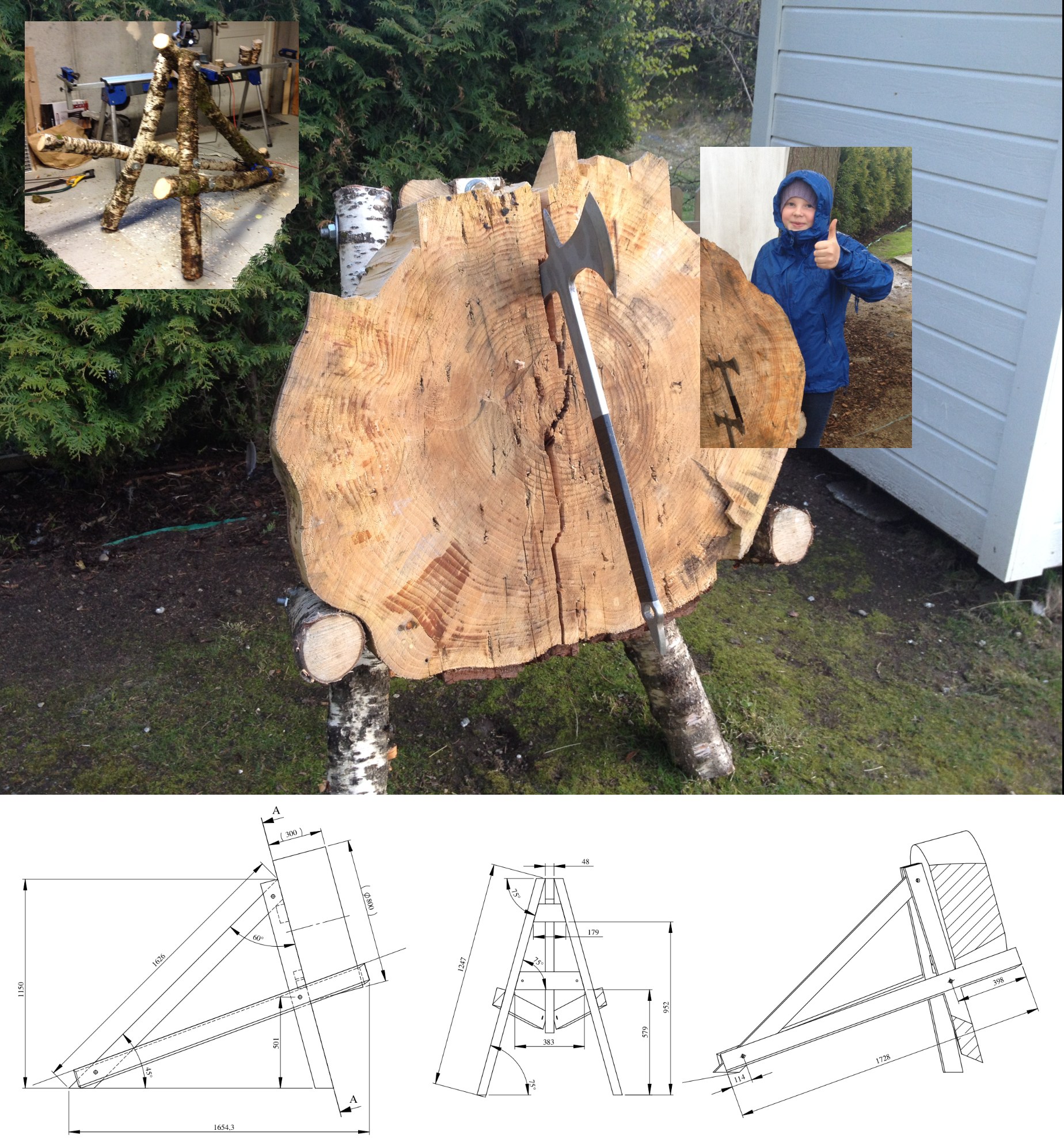
Markward Ringeling and his daughters are from Norway, and like to throw axes. Big axes from time to time. So their target had to be very sturdy, and it had to fit the rustic look of the surroundings.
The solution was again a tripod, made from birch log. It can support the sort of giant tree slices that hold up to axe impact. In this case the slice is cut from a Chilean pine that has grown very quickly - you can see the rings are quite far apart, making for a soft, stickable wood.
Construction was not done the rustic "we'll just nail it" way, but with careful planning - for details on how to build it you can consult the blueprint plans.
|
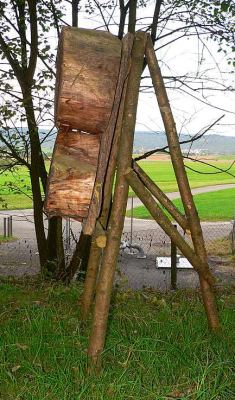
My friends and I throw knives, hatchets and axes at this target. It first stood on an open field, erected for the occasion of our WildWest club meeting. Afterwards, we disassembled the structure and moved it to our club's area. Above ground, the target has a height of 1,85m. The three supporting feet (diameter: 8-11cm, length: 2,6m) have been driven 40cm into the soil with a sledge hammer. On the top, where the three feet meet, three chipboard screws 6x190mm are screwed in a triangle. The stiffeners between the feet are screwed on with chipboard screws 6x110mm. The stiffeners themselves were flattened using an axe to give them a better connection with the feet. On the front, a board (length: 115cm, width: 50cm, thickness: 4cm) was screwed on with 6 chipboard screws (6x110mm). On top of this, you can screw on any tree round you like (coming from behind, using chipboard screws 6x150mm). My round has a diameter of 60cm and is 30cm thick. Christof Weese
|
 (bigger) |
This is the home-grown target of Jan Behrens. It consists of a tiny packaging palette with some timbers nailed on top. Jan used an electric planer to make it all the same height, so now he has an even surface. The target is about 1m x 1m wide an quite heavy, it can easily absorb the impact from the knives. The only problem here is the missing backstop, so one really has to be careful as to who is in the garden. The glass house in the background has survived so far... |
|
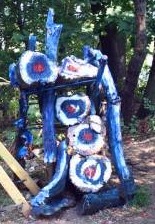
Target sculpture by |

